Stolen photographs, an address that is really a parking lot, and a price that doubles on the doorstep. The pattern is documented — here is how to check in under a minute.
On this page
A fake locksmith listing is not a rare thing you would be unlucky to hit. It is an industry, and the Greater Toronto Area has been one of its better markets for years. A CBC Marketplace investigation traced more than eighty bogus locksmith listings across the region, most of them sharing the same handful of stock photographs and pointing at addresses that turn out to be a parking space or an empty storefront.
The reason it works is timing. Nobody researches a locksmith in advance. You look one up while standing outside your own door, in the dark, on a phone at fourteen per cent battery — which is exactly the state of mind the listing is designed for. The checks below are the ones that survive that situation, because each of them takes under a minute.
What the fake locksmith scam actually is
The mechanism is consistent enough to describe in one paragraph. A call centre — often not in your city, sometimes not in your country — buys advertising for hundreds of neighbourhood-shaped business names. You call, you are quoted a low number, and the job is sold on to whoever is nearest and willing. That person arrives with no branded vehicle and no identification, declares the lock "high security", and produces a total several times the quote. Frequently they drill a lock that did not need drilling, because drilling is fast and it turns a fifteen-minute job into a hardware sale.
Notice what the customer is never given at any point: a name, an address, or a number in writing. Those three absences are the whole tell.
Five checks, one minute each
1. Find a street address, then look at it
Search the business name and read the address on a map, in satellite view. A legitimate locksmith has premises — a workshop, a unit, a storefront. If the pin lands on the middle of an intersection, a residential driveway, or a shopping centre car park with no matching sign, you have your answer before you have dialled.
2. Ask what business you have reached
The single most useful question is the simplest: "What company is this?" A dispatcher selling leads for forty listings has to answer vaguely, because they do not know which of the forty you called. A real business says its name without pausing.
3. Get a number in writing
Ask for the quote by text or email before anyone is dispatched. This is the check the scam cannot survive, because the whole model depends on the number changing later. Anyone unwilling to put a figure in writing has told you what the figure is for.
4. Ask how the door will be opened
The honest answer to this is usually "we will know when we see it, but almost certainly by picking or bypassing it". An answer of "we will have to drill it" before anyone has looked at your lock is not an assessment. It is a plan.
5. Look at what arrives
You are entitled to ask for identification and to see a business name on the vehicle or the invoice before work starts. An unmarked car alone proves nothing — plenty of small operators run a plain van — but an unmarked car plus no ID plus no paperwork plus a revised price is not a coincidence.
The four things that should end the call
- The quote is refused in writing, or given only as "starting from".
- The business name cannot be stated plainly on the phone.
- Drilling is proposed before the lock has been seen.
- The price changes at the door for a job that has not changed.
Ask for the job ID at the door
When you book with us, the job is given a job ID, and the technician we send knows that same ID. Before any work starts, ask for it. If the two match, the person at your door is the one we dispatched — not someone who picked up your call through a copied listing. It takes five seconds and it is the simplest check there is.
Insurance is a fair question to ask and a fair one to answer. If a business tells you it carries liability coverage, asking for the certificate is normal and nobody reputable is offended by it.
If you are already locked out right now
Do the address check and the written-quote check. They take about ninety seconds together and they remove almost the entire risk. Then read what actually happens when a locksmith arrives, so that the process at your door is one you recognise rather than one you are being told about by the person charging for it.
We are a mobile locksmith working out of a real address in Vaughan, and we will send you a number before we send you a technician. That is not a favour — it should be the floor.
(01)Objections
Frequently asked
- How do I know the technician at my door is the one I booked?
- Ask for the job ID. A legitimate business gives every job an ID when you book it, and the technician it sends knows the same ID. If the person at your door cannot tell you yours, do not let the work start.
- Should I get the price in writing before anyone comes out?
- Yes, and it costs you nothing to ask. Get the quote by text or email so there is a record, and confirm what it covers — the callout, the entry itself, and any hardware. The single most reported complaint in this trade is a number that changes once the technician is standing at your door.
- What if the price goes up when they arrive?
- You are entitled to stop. Nothing obliges you to accept a revised price for the job you already agreed, and no work has been done yet. Say you will not proceed at the new number, ask them to leave, and call someone else. If work has already started, do not sign anything you have not read.
(02)From readers
Questions readers asked
- The listing I found has a five-star rating with 900 reviews. Doesn't that mean it's fine?
- Not on its own. Review counts can be bought, and a common pattern is one review profile shared across dozens of listings under different names. Read the reviews rather than the number — genuine ones mention a specific street, a specific vehicle, a specific problem. If they are all one line long and posted in the same week, treat the rating as decoration.Asked by Danielle
(03)Ask
Have a question about this?
Questions are read by a person and answered here on the page. We don't collect your email, so we can't reply privately.
(04)Written by
LAK Locksmith Team
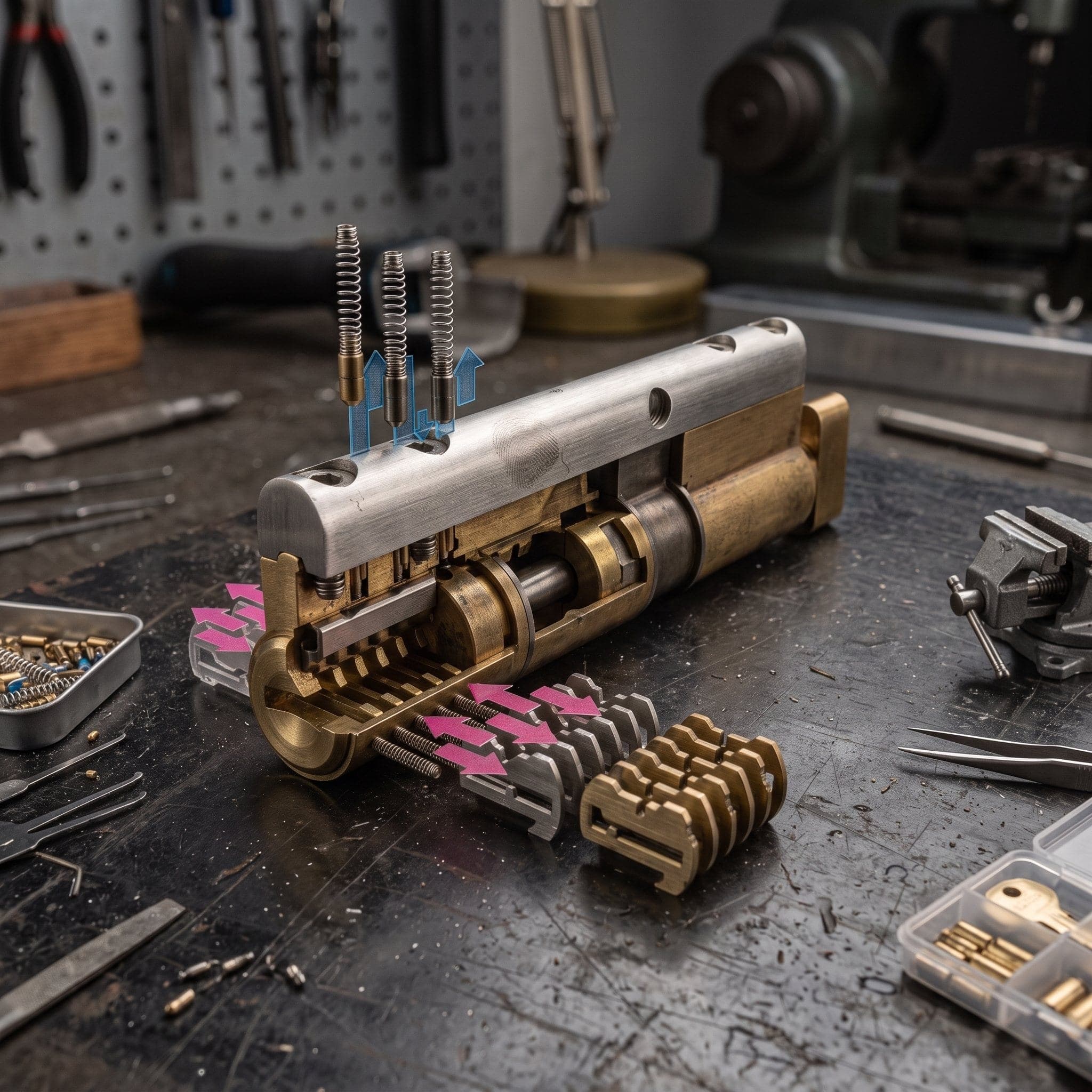
LAK Locksmith has been working across the Greater Toronto Area since 2021, from 470 N Rivermede Rd in Vaughan. These guides are written by the technicians who do the work — residential, commercial and automotive — and are kept to what can be demonstrated on a doorstep rather than what sells.